How to Build a Side Business Without Burning Out
Most advice focuses on fast growth. This is about building a side business you can actually sustain long term.
 Berge Dermelkonian
How to Build a Side Business Without Burning Out
Most advice focuses on fast growth. This is about building a side business you can actually sustain long term.
Every weekend, I sit across from people who are trying to build something on the side. Some are mid-career professionals who want more financial breathing room. Some are parents juggling a day job and a dream. Some are recent graduates who watched a company lay off a hundred people and decided they needed something that was truly theirs.
They're smart. They're motivated. And in almost every case, they're running on less sleep than they should be.
I understand the impulse completely. When you find an idea that excites you, there's a voice that tells you to go all in, treat every spare hour as an opportunity, to outwork the doubt, to prove to yourself and everyone else that you're serious. In the culture we've built around entrepreneurship, suffering is often treated as evidence of commitment. The person who sacrifices the most, sleeps the least, and posts about their grind at midnight is celebrated as someone who really wants it.
I want to push back on that. Firmly.
This isn't a soft problem
Before we talk about building a business, I need to spend a moment on what happens when ambition runs too far ahead of sustainability, because the consequences are far more serious than most people acknowledge.
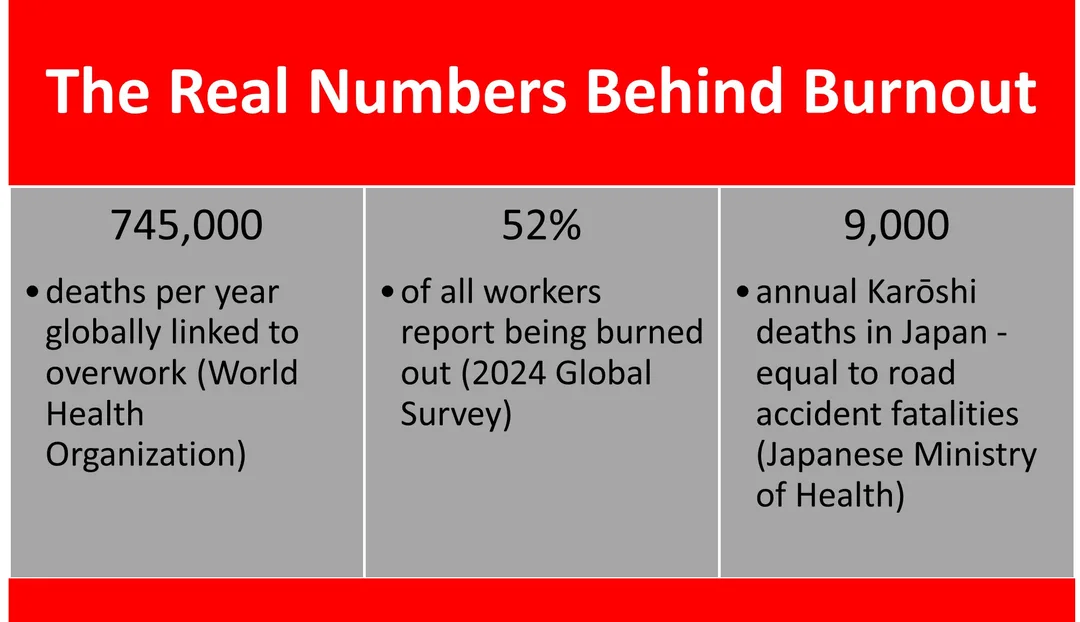
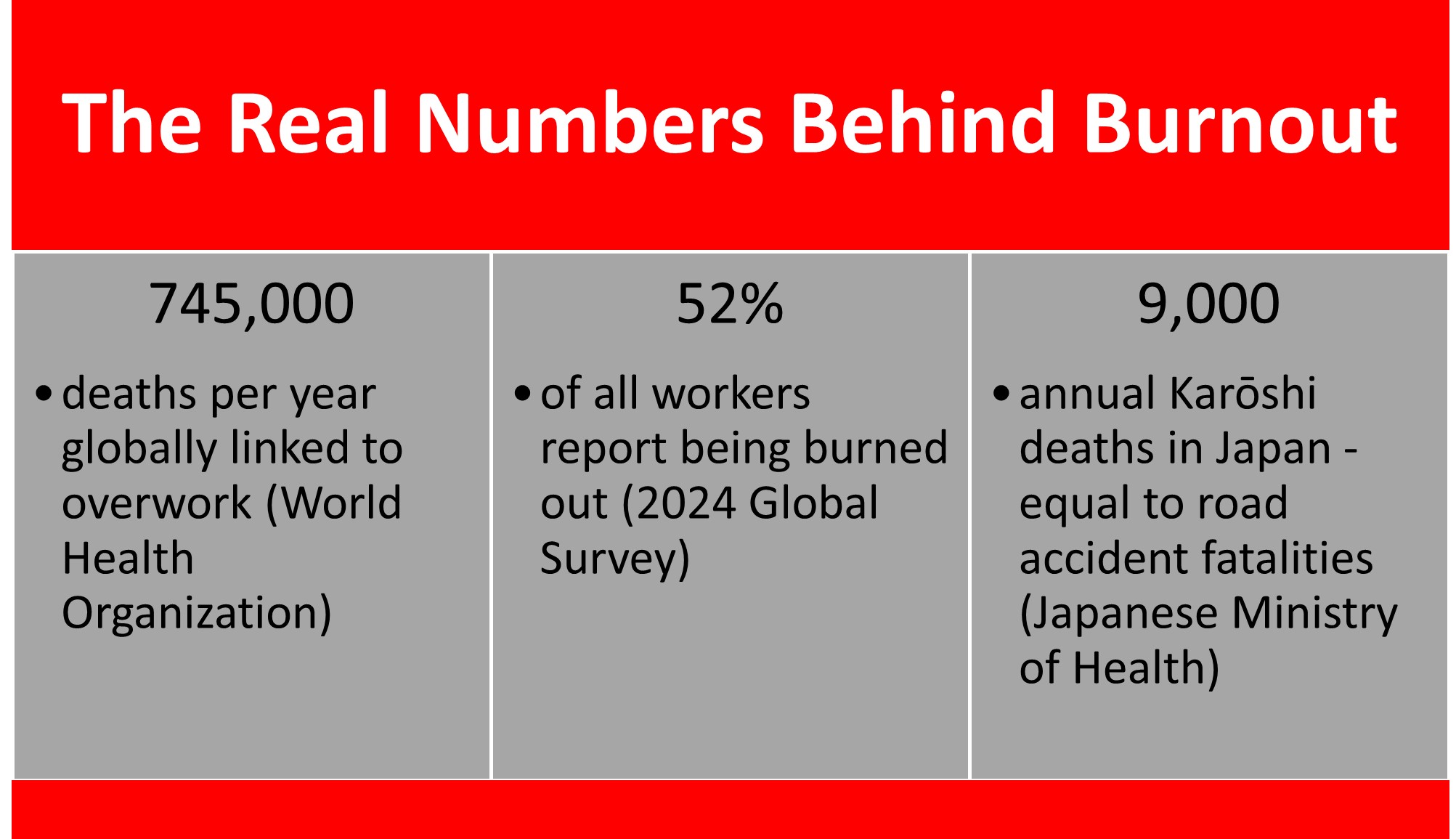
In Japan, overwork has its own vocabulary. Karōshi translates directly as death from overwork, not burnout, not exhaustion, but death. Cardiac arrest. Stroke. The result of years of extreme pressure with no meaningful recovery. The Japanese government officially recognized it as a cause of death after a 29-year-old worker died in 1969. It has never stopped happening. Researchers estimate roughly 9,000 people die from it every year, approximately the same number as die in road accidents.
Karōjisatsu is the second word for death by suicide caused by work-related pressure. One case that made international headlines involved a 24-year-old restaurant manager who logged more than 190 hours of overtime every single month for seven consecutive months before taking his own life. He was 24 years old.
These are not stories from a parallel world of extreme corporate culture. The World Health Organization estimates that overwork contributes to 745,000 deaths globally each year. A 2024 survey found that 52% of workers across industries currently describe themselves as burned out.
I'm not saying starting a side business will take you anywhere near those extremes. What I am saying is that we have normalized a relationship with work where pushing past your limits is admired, recovery is seen as weakness, and rest is something you earn rather than something you require. If you carry that mindset into building something on the side, you are building on a very unstable foundation.
"The entrepreneurs I've coached who built something lasting weren't the hardest workers in the room. They were the most consistent ones, and consistency requires that you still be standing a year from now."
What actually works, and why it fits your life
Here is the truth I share with every person I coach: the path to a real, sustainable side income is far less dramatic than the content you see online. It does not require waking up at 4 am, working through weekends until you collapse, or treating your family like a distraction from your real work.
What it requires is clarity about what you're offering, patience to build trust before you try to sell anything, and a system simple enough to run on evenings and weekends without taking over your entire existence.
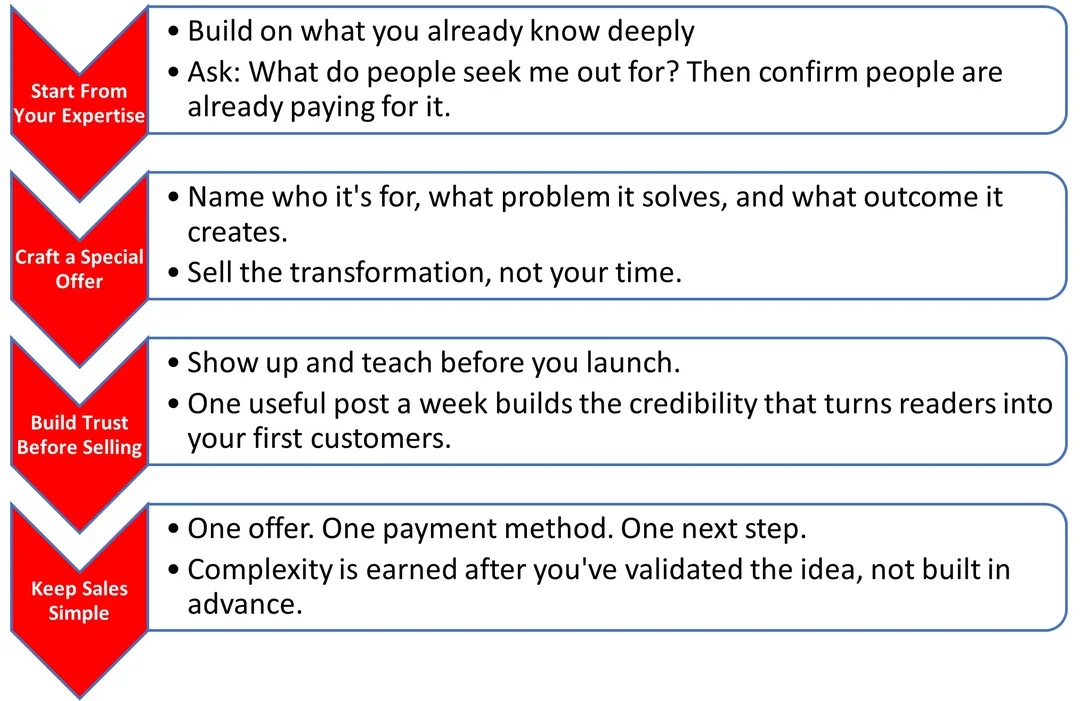
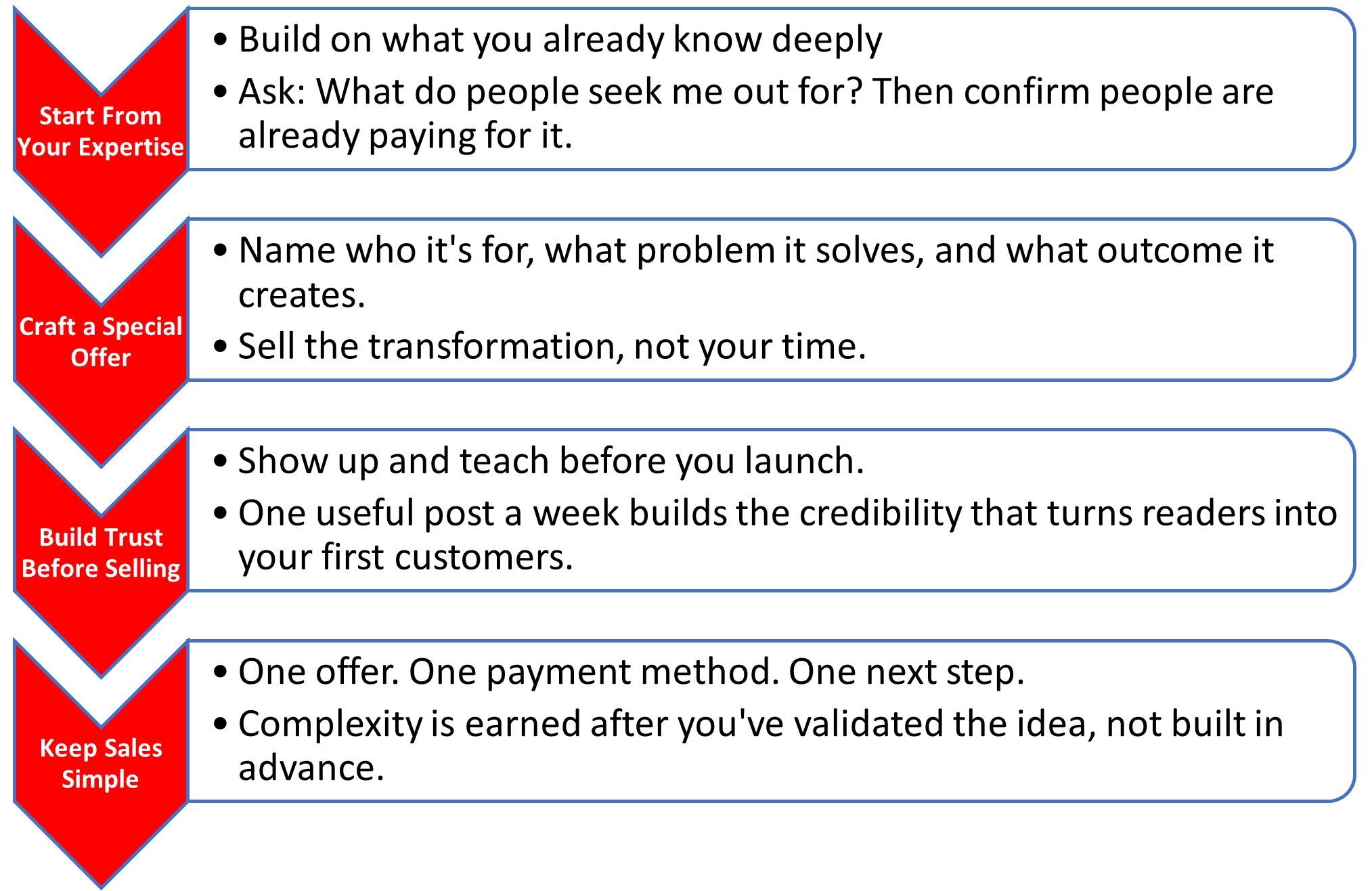
I call this the Weekend Venture System. A side business building framework that is summarized in four parts, and none of them are complicated, but all of them require you to resist the urge to rush.
1. Start from what you already know deeply.
The most common mistake I see is people chasing whatever trend is currently visible on social media. They see someone building a faceless YouTube channel about cryptocurrency or a print-on-demand store selling custom tote bags, and they try to copy it not because they know or care about those things, but because the numbers looked good. That is an expensive way to discover you have no advantage and no staying power in a market you don't understand. Start instead from genuine expertise. What do people in your life come to you for advice on? What problem do you understand at a level most people don't? What conversation could you sustain for hours without running out of things to say? That intersection of knowledge and genuine interest is where a real business begins. Then verify demand: not "do people like this idea?" but "are people already paying for something like this somewhere?" If yes, you have something real to work with.
2. Turn your expertise into a specific, outcome-focused offer.
Having knowledge is not the same as having a business. The bridge between the two is a clear offer of something specific that solves a defined problem for a defined person and delivers a tangible result. Vague positioning does not sell. "I help people improve their businesses" tells someone nothing useful. "I help first-time freelancers land their first three paying clients within 30 days," tells them exactly whether they need you. Your offer should answer three questions without hesitation: who it is for, what problem it solves, and what the person's situation looks like after working with you. I have written extensively about pricing strategy, and the principle I come back to most often is this: people do not pay for your time. They pay for the outcome you help them reach. Price your offer accordingly, and you will stop undervaluing your expertise.
3. Build a real audience before you try to sell anything.
This is the step most people skip because it feels slow and unsexy. But it is the single most important thing you can do before you launch anything. Spend four to six weeks; evenings and weekends only, sharing genuinely useful content with a small, consistent audience. One LinkedIn post per week that teaches something real. A short email to people you already know. A video where you explain something your target customer struggles with. You are not trying to accumulate followers. You are trying to become a trusted, recognizable name to a small group of the right people. When you eventually open for business, those people already believe you know what you're doing. They become your first customers, and they refer others. The side business that launches into an existing audience of even 200 engaged people has an enormous advantage over one that launches into silence.
4. Keep your sales and delivery structure as simple as possible.
One offer. One way to pay. One clear next step for someone who is interested. That is a complete business model, and it is all you need to get started. The temptation to build a beautiful website, create multiple service tiers, run paid advertising, and set up complicated email sequences before you have a single paying customer is a procrastination strategy dressed up as productivity. Build the minimum structure needed to take money and deliver value. Prove the idea works. Then add complexity only as a response to real demand, not in anticipation of it.
The part most business advice deliberately leaves out
Now I want to talk about the piece of this that almost no one in the entrepreneurship space addresses with real honesty: protecting yourself while you build.
When a new idea takes hold, it is easy to let it consume every available hour. You stay up later than you should. You skip the gym because you're "in a flow state." You cancel plans with friends because you're "so close to finishing something." You eat badly because you're too busy to think about food. Each of these feels like a small sacrifice in service of something bigger.
But each one also degrades the one resource your business depends on entirely: your ability to think clearly, make good decisions, and show up with energy and judgment day after day. When that resource runs low, everything suffers. You take on clients who aren't a good fit because you're desperate for revenue. You underprice your work because anxiety is making the decision instead of a strategy. You make commitments you can't keep and damage relationships that took years to build.
Dr. Sherry Walling, a clinical psychologist who works specifically with entrepreneurs, puts it plainly: building a business is a marathon, not a sprint. The last founders are not the ones who worked hardest in the first six months. They're the ones who were still healthy, motivated, and thinking clearly three years in.
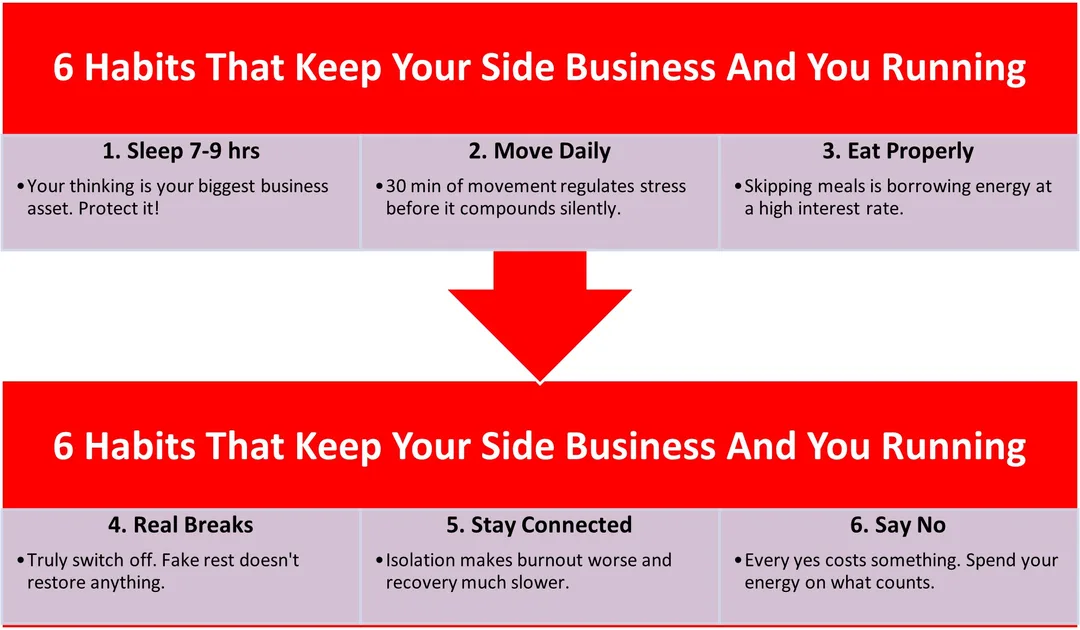
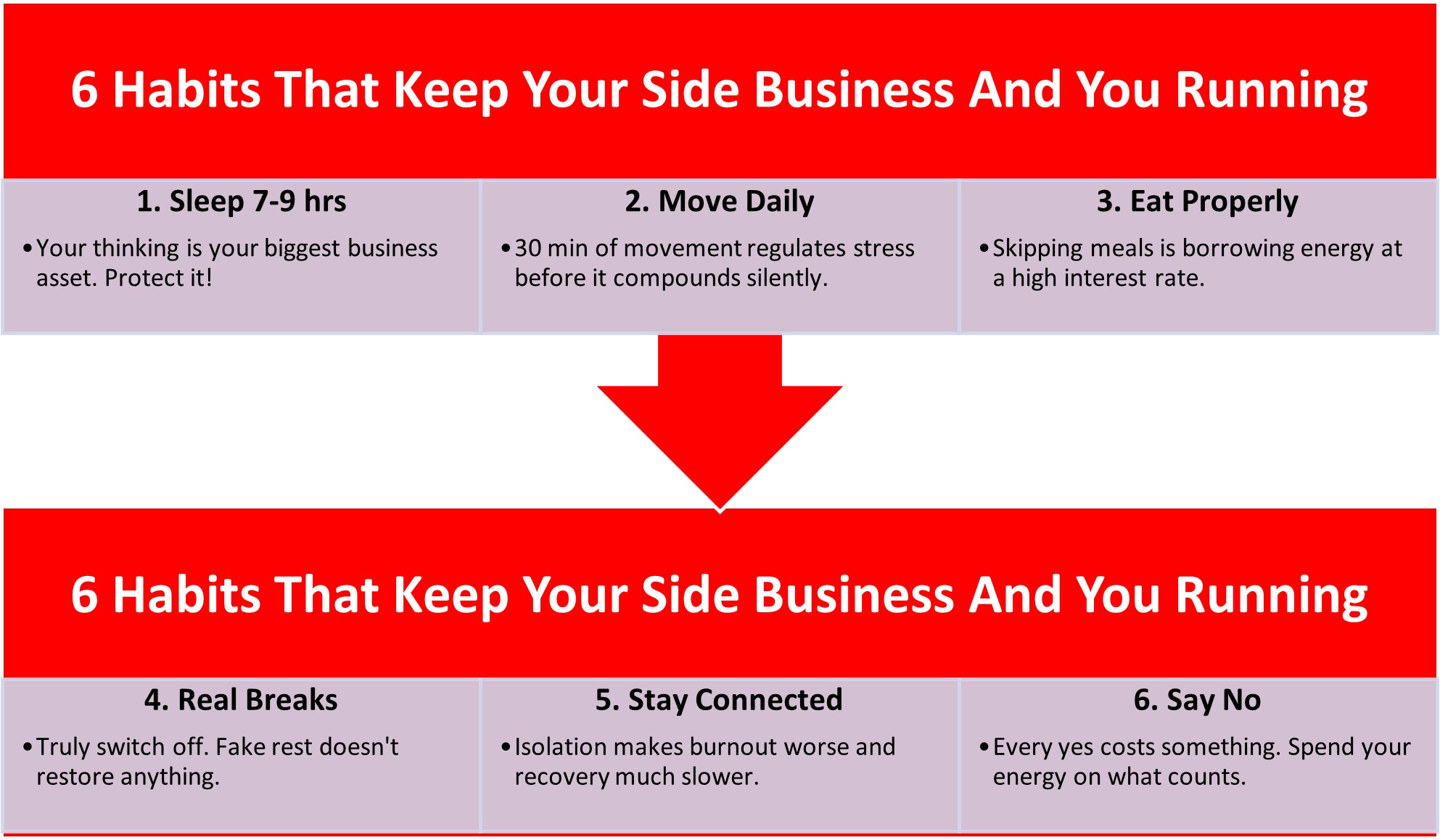
Here is what that looks like in practice:
- Protect your sleep. Seven to nine hours is not a luxury; it is the maintenance schedule for your most important business tool. Sleep-deprived thinking is measurably worse in every dimension: slower, less creative, more reactive, more prone to poor decisions.
- Move your body daily. Thirty minutes of movement, a walk, consistently reduces the cortisol that accumulates from sustained stress. This is not about fitness; it is about keeping your nervous system from quietly working against you.
- Eat with intention. Surviving on coffee and skipped meals feels like efficiency. It is actually a slow withdrawal from your energy reserves, and the interest compounds faster than you expect.
- Take genuinely restorative breaks. Research on recovery is clear: breaks only restore you if your mind actually disengages. Lying on the couch while mentally drafting tomorrow's to-do list is not rest. Permit yourself to fully switch off.
- Invest in your relationships. The people in your life are not obstacles to your success. They are part of what makes success worth pursuing. Burnout research consistently finds that isolated people hit harder and recover more slowly. Protect those connections.
- Learn to say no strategically. As psychotherapist Tiffany Green puts it: every commitment costs something. The discipline of protecting your energy by evaluating each new obligation against what it will actually cost you is one of the most important skills a founder can develop.
I will be transparent: there are weeks when I am more visible and weeks when I am quieter. That is not inconsistency; it is a deliberate practice of listening to what my body is telling me. When I feel depleted, I step back. I sleep. I do things I enjoy that have nothing to do with work. And then I come back with the clarity and energy to actually produce something worth putting out into the world.
The people I have seen build the most durable, genuinely successful side businesses are not the ones who made the greatest early sacrifices. They are the ones who treated themselves as an asset worth protecting and built accordingly.
A side business that generates real income and fits inside a full, healthy life is not a fantasy. I have watched people build it, and I have built it myself. But it requires a different mindset than the one the internet sells, one that measures success not just in revenue milestones, but in whether you can still look at the business five years from now without resentment.
Build the offer. Build the audience. Keep the system simple. And build in a way that keeps you standing.
The business is worth building. So is the life you are building inside of.
Join my FREE newsletter THE WEEKEND VENTURE