
The Label Problem
Why Calling It a "Side Hustle" Is Costing You a Real Business
Most entrepreneurs don't fail because they lack talent, capital, or time.
They fail because of a word.
Not a dramatic word. A casual one, the kind you drop in a conversation without thinking. The kind that quietly sets a ceiling on everything you build.
That word is hustle.
What You Call It Determines What It Becomes
Language is not neutral in business. The terms we use to describe our ventures shape how we invest in them, how we price our services, how we show up for clients, and ultimately, how far they grow.
When you call something a side hustle, you have already made a series of invisible decisions:
- It does not need a system, just effort
- It does not need a pricing strategy, just a rate
- It does not need a growth plan, just more clients
- It does not need mentorship, just time
None of those decisions is stated out loud. But they are all embedded in the label. And because they are invisible, they are almost impossible to challenge.
The result? You can spend twelve months working weekends, serving clients, and generating revenue, and still have nothing to show for it in terms of business equity, brand, or systems. You have traded your Saturdays for income without building an asset.
That is the hustle trap. And it is not about how hard you work. It is about what you believe you are building.
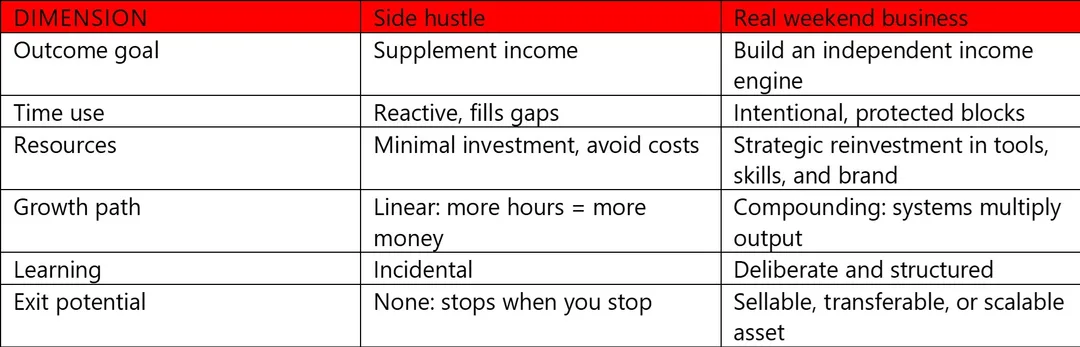
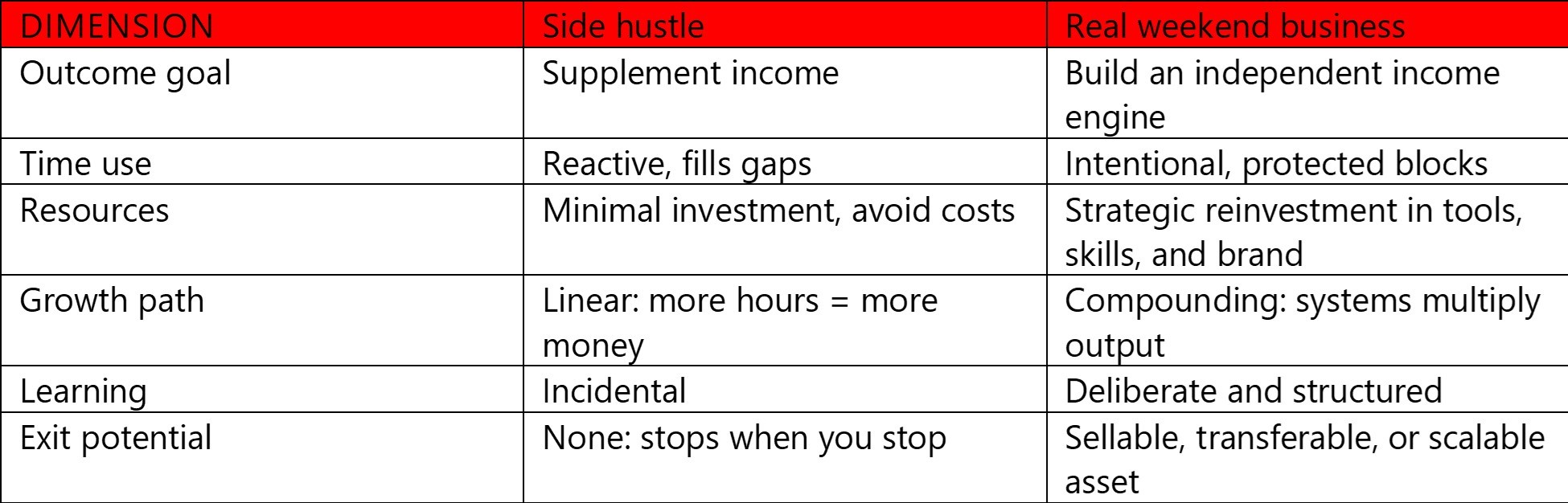
The Real Difference Between a Hustle and a Business
This is not a philosophical distinction. It has direct, practical consequences for every decision you make.
A side hustle is optimized for now. It converts your existing skills into immediate income. There is nothing wrong with that as a short-term objective. But the architecture of a hustle transactional, reactive, founder-dependent makes it structurally incapable of becoming a real business without a deliberate reset.
A real business, even one you run on weekends with limited hours, using a structured business-building system, is optimized for compounding. It builds repeatable processes. It creates a client journey rather than a client list. It tracks metrics and adjusts. It owns distribution channels that outlast any single campaign. And critically, it is designed to grow beyond the direct hours its founder puts in.
The distinction is not revenue. It is not hours worked. It is not whether you have a registered entity or a logo.
It is intent and architecture.
Here is the diagnostic question worth asking yourself honestly: If your venture disappeared tomorrow, what would actually be lost?
If the answer is "some extra income," you have a hustle.
If the answer is "a system I've built, a brand I've grown, and clients I've earned trust with," you have a business regardless of how many hours a week you run it.
The Four Structural Gaps That Keep Hustles from Becoming Businesses
Over years of coaching founders and early-stage entrepreneurs, I have noticed that the gap between a side hustle and a real business almost always comes down to four missing elements. Not skills. Not funding. Structure.
1. Positioning Without Apology
A hustle says: I can do X. Let me know if you need it.
A business says: I solve this specific problem for this specific type of client, and here is exactly why my approach is different.
If you cannot articulate your positioning in one sentence, who you serve, what problem you solve, and why your approach is distinct, you are not yet ready to grow. You are still in the exploration phase, which is fine, but name it honestly.
Exploration and building are different modes, and confusing them is expensive.
Strong positioning does three things simultaneously: it attracts the right clients, it repels the wrong ones, and it makes your pricing defensible. Without it, you will constantly undercharge and over-explain.
2. Pricing as Strategy, Not Guesswork
One of the most common symptoms of hustle thinking is reactive pricing. You charge what feels reasonable. You discount when a prospect hesitates. You anchor your rates to what you think the market will tolerate rather than what your solution is actually worth.
Pricing strategy is not about charging more for its own sake. It is about aligning your price with the value architecture of your offer. That means understanding what outcome your client is actually buying, what alternatives they are comparing you against, and what the cost of not solving their problem looks like.
Founders who treat their weekend venture as a real business with intent, test price points, track conversion rates at different price levels, and use pricing as a signal of positioning. Those who treat it as a hustle set a rate once and never revisit it.
That difference alone can represent a 40–60% gap in revenue on identical work.
3. One Owned Channel That Compounds
The most dangerous trap for any early-stage business is renting your audience.
Social media reach is borrowed. Referrals are unpredictable. Paid acquisition is expensive. The founders who build durable businesses invest early in one channel: they own an email list, a podcast, a consistent content presence that grows over time, and does not depend on an algorithm's goodwill.
This is not about becoming a content creator. It is about building a distribution asset. A weekly newsletter with 800 engaged subscribers is a business asset. An Instagram account with 8,000 followers you do not own is a borrowed audience.
Builders understand this. They commit to one owned channel early, show up consistently, and let it compound. Hustlers skip this step because it does not produce immediate income, and that decision costs them enormously when they try to scale.
4. Mentorship and a Feedback Loop
The research on this is unambiguous: mentored founders grow faster, make fewer costly mistakes, and are significantly more likely to reach sustained profitability. Mentorship is not a soft benefit or a luxury for when you have more time. It is one of the highest-return investments a founder can make in the early stages.
But beyond formal mentorship, every real business needs a feedback loop. What gets measured improves. What goes unmeasured drifts.
Track your revenue month over month. Track your lead sources. Track your conversion rate from conversation to client. Track client satisfaction. Once a month, review the numbers and ask a single question: What is this data telling me that I would not have noticed otherwise?
That practice, simple, undramatic, consistent, is what separates ventures that grow from ventures that plateau.
Why Failure Gets Misattributed
The most damaging pattern I see as a venture coach is not failure itself. Failure is information. The most damaging pattern is misattribution, concluding that you are the problem when the real problem was the structure you gave your venture from day one.
The story usually goes: someone spends six to twelve months building something on the side. It gains no traction. They conclude that entrepreneurship is not for them, or that the market is too crowded, or that the timing was wrong.
When I ask how they approached it, the answer is almost always the same: inconsistent effort, no defined client process, no tracking, no pricing strategy, no mentorship, no market research. In other words, they ran a hustle and expected business results.
Before you decide entrepreneurship is not for you, ask honestly: Did you give your venture the conditions a real business needs? Or did you give it hustle conditions and hustle infrastructure and then wonder why it produced hustle outcomes?
A real weekend business demands exactly what a full-time business demands, just compressed into fewer hours. Clear positioning. Consistent client communication. Strategic pricing. A content or referral engine. A feedback loop. Mentorship.
These are not features you add when you go full-time. They are the conditions that make going full-time possible.


A Framework for the Reset
If you recognize your venture in this piece, the shift does not require quitting your job or overhauling everything at once. It requires one clear decision: to stop treating your work as a hustle and start treating it as what you want it to become.
Here is a practical framework to make that shift concrete:
This week: Write one sentence that defines your positioning, who you serve, what you solve, and why your approach is distinct. If it takes you more than an hour, that is your most important work right now.
This month: Review your pricing. Ask whether your current rates reflect the value you deliver or the discomfort you feel charging more. Raise your rates on new clients by a meaningful amount and observe what happens.
This quarter: Commit to one owned channel. Not three. One. Show up consistently for ninety days before evaluating results.
Ongoing: Find a mentor, a coach, or a peer group of founders a step ahead of you. The compounded value of that relationship will outperform almost any other investment you make in your business.
The Weekend Is Not the Constraint
The most liberating reframe for any founder building something on the side is this: the weekend is not a limitation. Thousands of businesses have been built in ten to fifteen hours a week. The constraint is not the schedule.
The constraint is what you believe you are building when you sit down on Saturday morning.
Call it a hustle, and you will optimize for this week's income.
Call it a business and mean it, structure it as a real weekend business, and you will optimize for something that outlasts this week, this month, and eventually, your current job.
The label is a choice. So is what comes next.
Join my FREE newsletter THE WEEKEND VENTURE